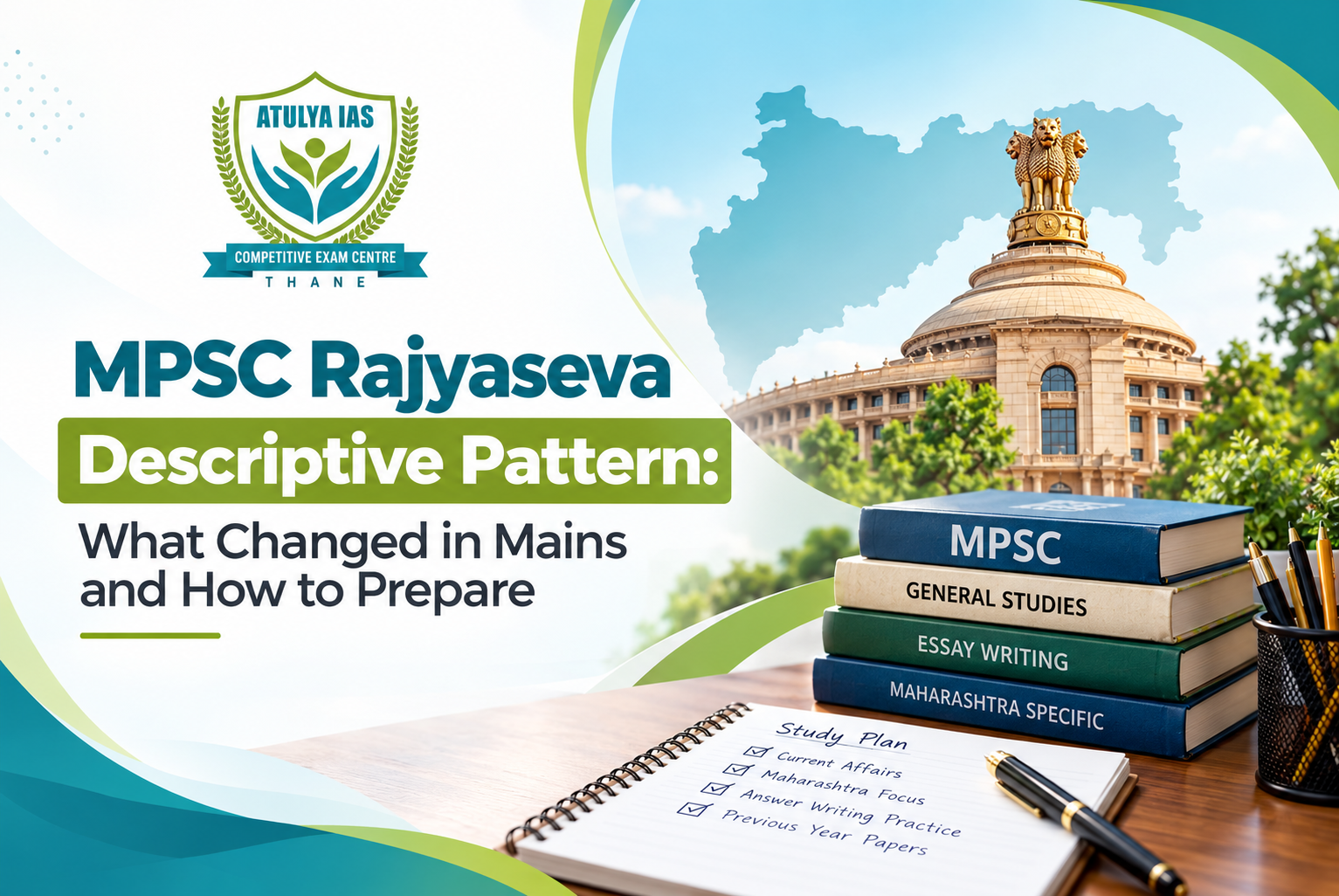
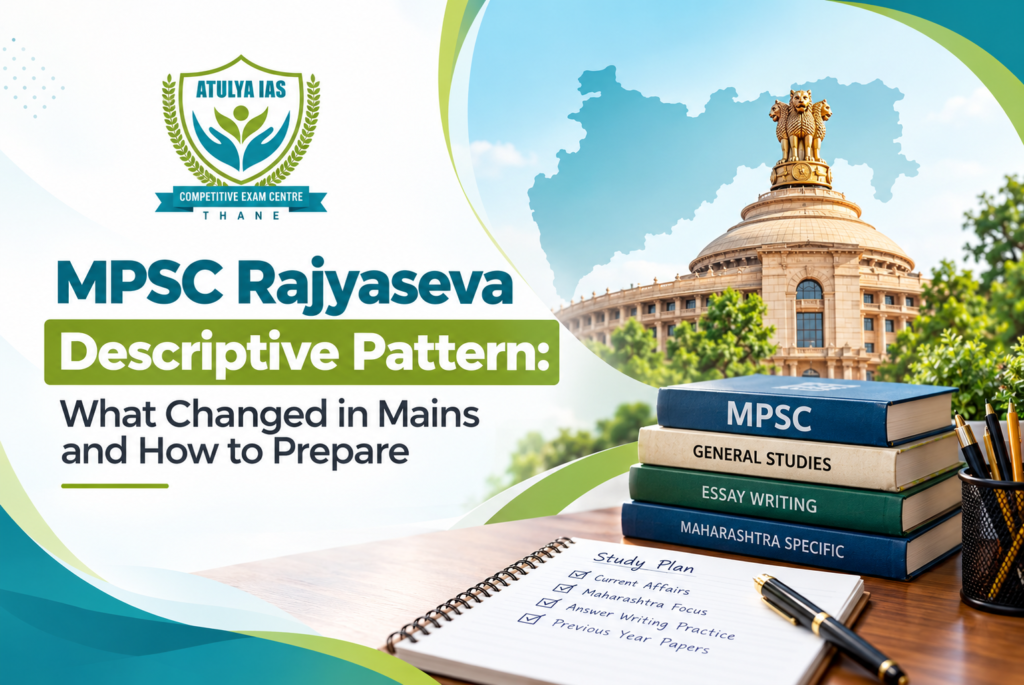
The 2025 Maharashtra Public Service Commission’s Rajyaseva examination marked the first change in almost a decade, shifting the mains test pattern from the usual objective questions to a more detailed, demanding subjective or descriptive format. For those who have been in the exam cycle for at least the previous 2 attempts, this was a big challenge. For first-timers, it is more of a golden opportunity, as they now stand in the same position as students who have been through more than one exam cycle.
The MPSC Rajyaseva descriptive pattern
Start with the old MPSC mains exam pattern, since most of the study material floating around was built for it: six papers, 800 marks, and General Studies papers made of multiple-choice questions. You read, recalled, eliminated two options, and picked from the rest.
The revised MPSC mains exam pattern has nine papers, and all of them are descriptive. Each runs for three hours. Two are language papers, Marathi and English, which only qualify you and add nothing to your merit score. The other seven count: an Essay paper, four General Studies papers, and two optional papers, 250 marks each. That takes the Mains merit total to 1,750 marks, up from 800.
|
Old Mains |
Revised Mains |
|
|
Papers |
6 | 9 |
|
Merit marks |
800 | 1,750 |
| GS papers | Objective |
Descriptive |
| Optional subject | None |
Two papers |
The prelims exam pattern remains the same. It is still objective, and it still only decides who gets to write the Mains. But the weight has moved. With 1,750 marks on offer, the descriptive stage is now built in
What the MPSC descriptive exam asks that MCQs never did
A multiple-choice paper checks whether you can mark the right answer, so it’s either black or white. A descriptive paper checks whether you can produce a neutral and well-balanced answer and put forth all your views, in your own words, against the clock. These are different skills, and strong MCQ scorers are often surprised by how little the first helps with the second.
Take Panchayati Raj. In the old format, you needed to know which amendment gave it constitutional status. Now you might be asked what has worked at the village level in Maharashtra and where it has fallen short- same topic, completely different preparation.
Then there’s the huge hurdle of time management. Three hours per paper means every question has a time budget, and you need to know it before you sit down. A brilliant answer to question three that costs you the last two questions is a bad trade. Practise that discipline now, because you can’t improvise it on the day.
This is why the change has a two-way effect. Repeaters carry habits built for objective papers, like skimming and elimination, and they have to unlearn those, not entirely, since they still have preliminary objective papers to tackle. Still, for the MPSC Mains descriptive exam, you need proper skill-building. First-timers have nothing to unlearn. If they start writing early, they can close the gap faster than they expect.
How to prepare for the descriptive Mains
Start writing in the first month, not the last. A familiar mistake is finishing the syllabus first and promising to practise writing later. Three hours of continuous handwriting is a physical skill. Begin with one answer a day, even a short one, and build towards full timed papers.
Learn the shape of a good answer. It opens quickly, looks at the question from more than one angle, and closes with a line that adds something. Keep the sentences plain, because a clear line scores better than an ornate one that hides the point. Use a Maharashtra example, a state scheme or a committee report wherever the question allows. You can also practise with UPSC Mains questions on the same themes, then rewrite the answer with a state angle.
Study the questions MPSC has already set. Collect the descriptive papers available so far and read them closely. Notice how the questions are worded, whether they ask for analysis or an opinion, and how often they bring in state-level material. Also decide which language you will write in, Marathi or English, and practise only in that one so your speed and vocabulary build together.
Pick your optional early. Two papers of 250 marks each mean the optional carries the same weight as two GS papers. Check how much it overlaps with your GS preparation, since History, Geography and Sociology share a lot of ground with the GS syllabus. Interest matters too. You will spend months with it.
Turn current affairs into arguments. Headlines won’t earn marks in a descriptive paper. For every major issue, keep a few lines on the cause, who is affected, what the government has done, and what remains unsolved. Keep a Maharashtra lens, because state schemes and local governance are fair game.
Revise by rewriting. After finishing a topic, close your notes and write the answer from memory. Where you stall is the part you haven’t actually learned yet.
Give the Essay and language papers a weekly slot. The language papers carry no merit marks, but they are qualifying, and the Essay is 250 marks you can improve with practice. Write one essay a week and read it back the next day.
Practise full three-hour papers and get them checked. Writing without feedback only repeats your habits, good and bad. Ask a mentor, a peer, or a test series that evaluates answers to show you where marks are leaking: structure, relevance, or time.
Keep the Prelims alive. It is still the gate, so keep revising for it alongside your writing practice. Our six-month MPSC Prelims plan covers that side.
Preparing with the right structure
The new pattern asks for a different rhythm: read, write, get corrected, repeat. At Atulya IAS in Thane, our one-year MPSC Rajyaseva & Combined Exam Integrated Batch is built around both Prelims and Mains, aligned with the latest pattern. It includes printed notes, topic-wise and full-length test series, recorded lectures for revision, and mentoring from UPSC- and MPSC-selected candidates. Personalised study strategies and regular mentor support help you see where your answers need work. Mock interview guidance is there for the stage after the Mains.
The MPSC Rajyaseva descriptive pattern rewards a simple habit: write early, get it checked, fix what the feedback shows. First attempt or fourth, the aspirants who start now will reach the next Mains hall having already done it many times.