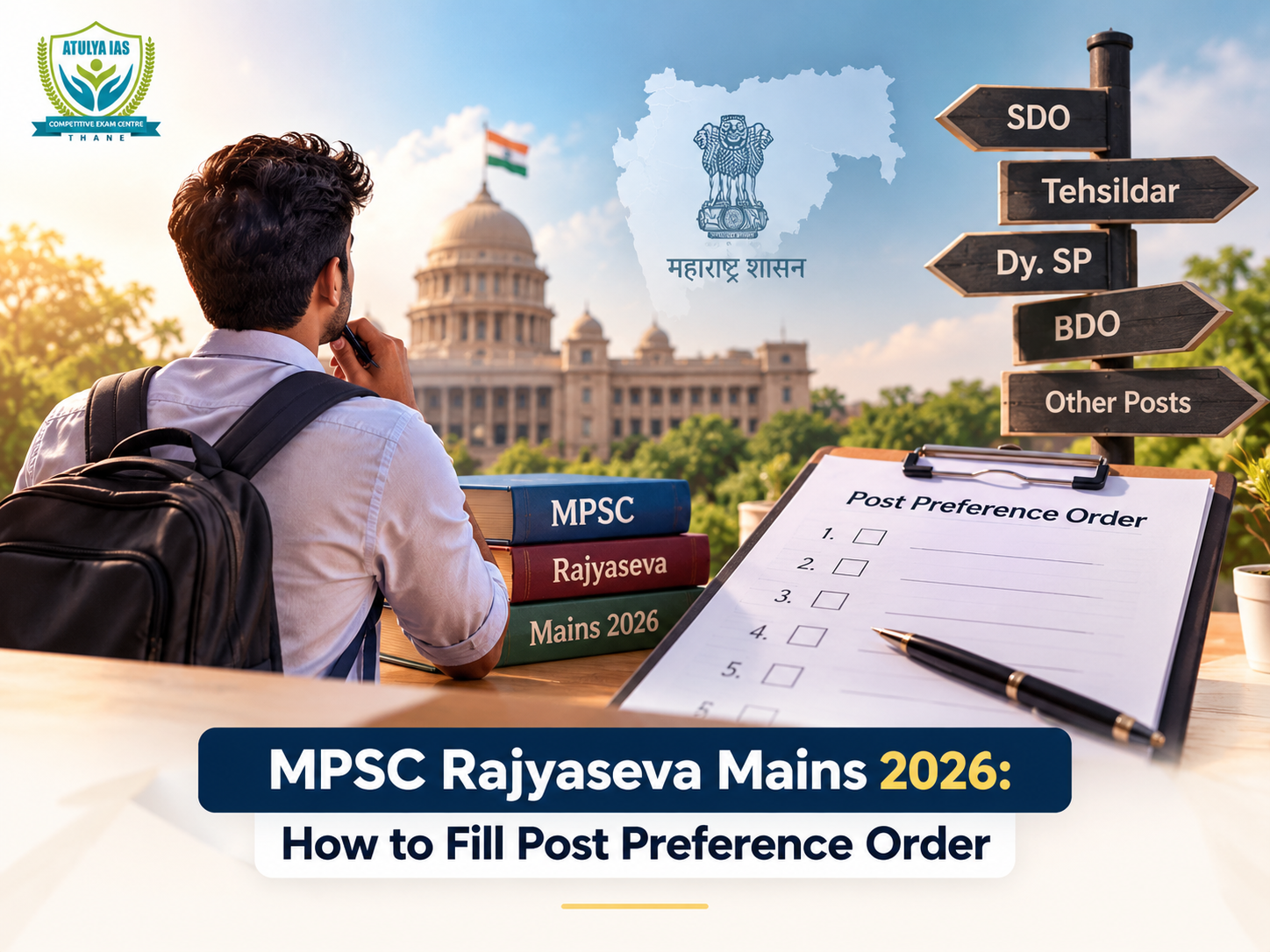
Most Rajyaseva aspirants usually spend almost a year, sometimes several, preparing for the exam itself. Very few spend even an evening thinking through their MPSC Rajyaseva post preference before they submit it. When asked most candidates why they ranked a particular service third or fifth, the honest answer is usually that they filled it in quickly, somewhere between uploading documents and paying the fee, without giving it the same weight they gave a single mains answer. That is a mistake worth correcting now, before the mains this October, because the MPSC Rajyaseva post preference order you fill can matter almost as much as your final rank. A strong rank with a careless preference list can still land you in a service you never actually wanted.
What Post Preference Actually Means in Rajyaseva
The Maharashtra Civil Services Gazetted Examination, which most aspirants also call Rajyaseva, does not recruit for a single post;d it’s a gateway to various posts. It recruits, in one combined cycle, for a set of Group A and Group B services under the Maharashtra government. This year’s notification covers 79 vacancies across posts like Deputy Collector, Assistant Superintendent of Police (which becomes Deputy Superintendent of Police after training), Tehsildar, Assistant Regional Transport Officer, Assistant Commissioner of State Excise, Assistant Director, and a few others tied to specific departments.
Aspirants do not apply separately for each of these positions. When filling the application, candidates can select and rank the services for which they are eligible and interested.
That ranked list is the actual MPSC post preference list. Some services have their own eligibility conditions. Assistant Regional Transport Officer, for instance, generally requires a science or engineering background with physics and mathematics. Deputy Collector and Tehsildar are open to graduates from any stream. So your list is shaped first by what you actually qualify for, and only then by what you want.
How Merit and Preference Work Together
Once MPSC combines mains and interview scores into a final merit list, it allocates posts using merit-cum-preference. In plain terms, a candidate higher on the merit list gets first claim on the services they have listed, ahead of someone ranked lower, provided they are eligible for that service and vacancies remain.
If your top preference already has fewer seats than the number of higher-ranked candidates who also chose it, you will not get it, no matter how well you write your papers. You will instead be considered for your next listed preference, and so on down the list.
This is exactly why setting a correct preference matters, not just the list of services you include. A candidate who ranks their true first choice fourth, out of caution or habit, can end up allotted a post they never actually wanted, simply because it appeared higher on paper.
Getting to Know the Posts Before You Rank Them
It helps to actually understand what a working week looks like in each service rather than ranking by name recognition alone.
Deputy Collector sits in the revenue administration line, dealing with land records, disaster response, and district-level coordination, mixing desk work with fieldwork. Deputy Superintendent of Police is a field-heavy, law-and-order role with physical demands, frequent transfers, and longer hours by nature of the job. Tehsildar operates closer to the ground at the taluka level, handling revenue disputes and public grievances directly. Assistant Regional Transport Officer deals with vehicle registration, licensing, and enforcement, more technical and procedural than the others. Assistant Commissioner of State Excise involves regulatory and enforcement work tied to excise law.
None of these is objectively “better.” They differ in pace, exposure to the public, physical demands, promotion timelines, and how much of your career gets spent transferring between postings. If you have never seriously thought about which of these suits your temperament, this is the moment to do it, not after you have already been allotted one.
Building Your List: What to Actually Weigh
A few questions are worth sitting with before you rank anything.
- Do you want administrative work with a broader policy angle, or do you prefer a role with visible field authority and quicker public interaction?
- How do you feel about frequent transfers and postings in remote talukas, which are more common in some services than others?
- Are you comfortable with the physical training and fitness expectations that come with police services?
- Does the promotion path from your entry post align with where you eventually want to be, ten or fifteen years in?
- Would you genuinely accept your fourth or fifth choice, or are you only listing it to appear open on paper?
That last point matters more than aspirants tend to think. There is no benefit in padding your list with a service you would refuse if actually allotted. If you would rather reattempt the exam than join a particular post, leave it off the list rather than including it out of habit.
Common Mistakes Aspirants Make
Ranking by salary alone is a frequent error, since pay scales across these Group A and B posts are broadly comparable once you account for allowances and promotions. Another is copying a senior’s preference order without checking whether your own eligibility or comfort with transfers even matches theirs. A third, quieter mistake is leaving the ranking for the last possible day, when it deserves the same attention as a mains answer.
It also helps to talk to someone who has actually worked in or closely observed these services, rather than relying only on what a coaching WhatsApp group says about a particular post. Perceptions about which service is “better” travel fast among aspirants and settle into conventional wisdom long before anyone checks whether it still holds true. Preference decisions made on outdated assumptions are hard to undo once the allotment order is out.
Where CD Institute Fits Into This
At C D Deshmukh Institute in Vartak Nagar, Thane, a large share of our Rajyaseva batch commutes in from across the Mumbai region, and preference-order questions come up every single cycle, usually right around this time of year. If you are searching for MPSC classes in Mumbai and want a centre that is easy to reach from the western and central suburbs by local train, our Thane campus works well for exactly that reason. Beyond the mains preparation itself, our mentors, many of whom have guided candidates through past allotment cycles, sit with students individually to think through their preference list rather than leaving it to guesswork on the final day. If your mains is scheduled for October, it is worth having that conversation now, while you still have the time to think it through properly.