Somewhere between Class 12 boards and the first year of college, most defence aspirants start to get anxious and find answers to their career-related questions like:
Both exams come from UPSC, so can one study plan cover both? Partly.
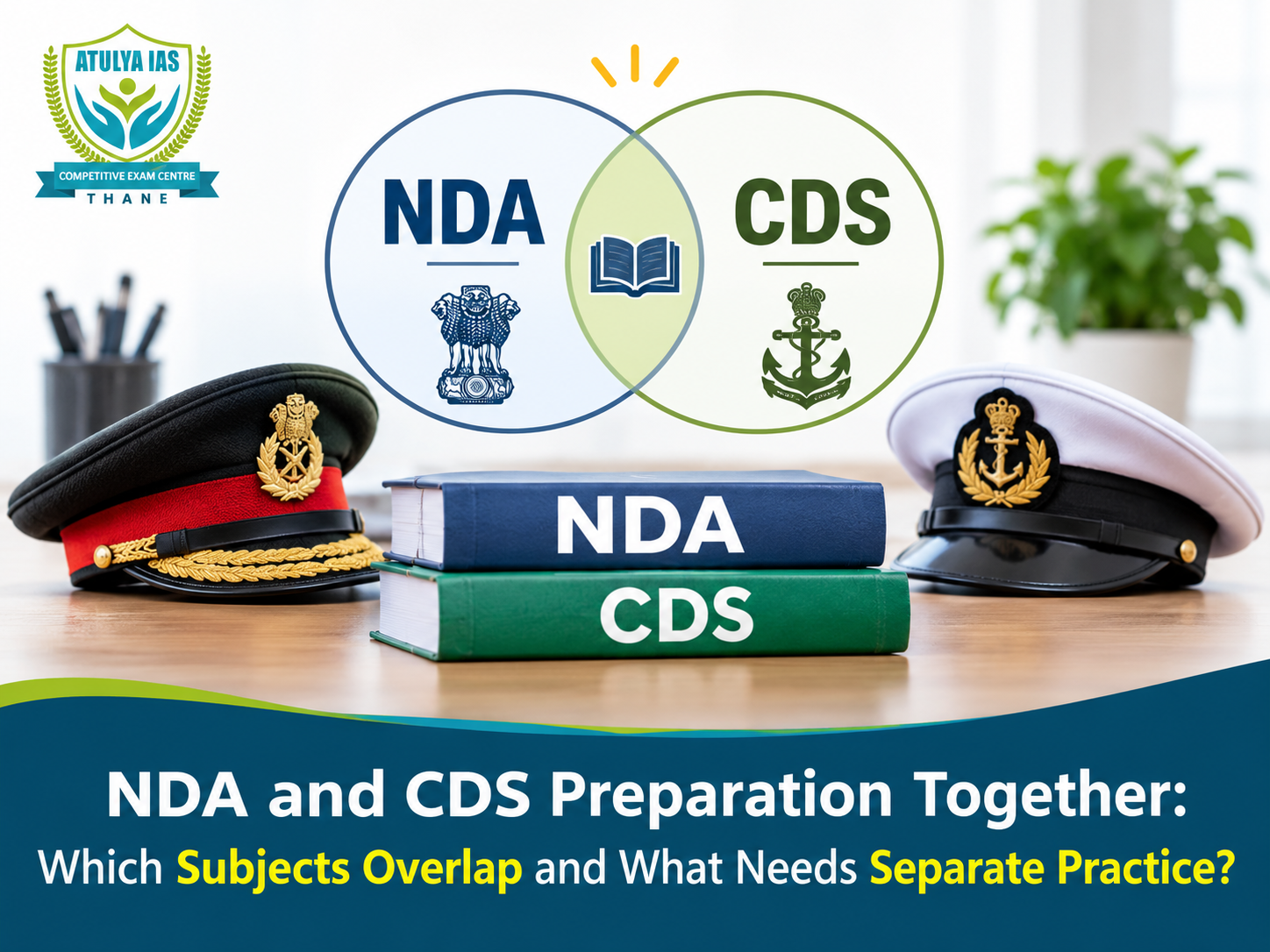
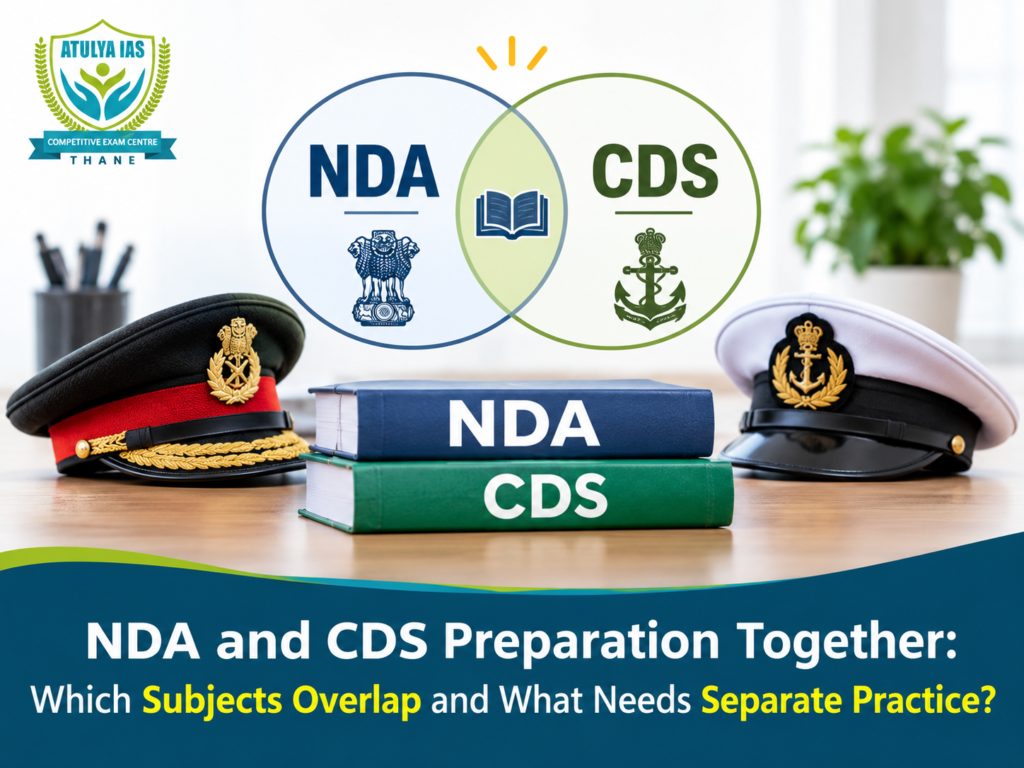
NDA and CDS preparation share a real core, as most of the other exams conducted by the same commissions do, but the overlap is lopsided, and the non-overlapping parts are where marks quietly disappear. Even though many think that they can cover this part, it is way more time-consuming if you are also working on your physical requirements at the same time.
Firstly, let’s have a look at the fact that changes how you plan. The NDA is taken after Class 12. The CDS needs a degree, or at least that you are in the final year of one. So “together” rarely means the same month. It usually means building one foundation early and carrying it into CDS exam preparation a few years later. Secondly, each of these exams has its own dedicated cycles that decide when and how your actual preparation will begin.
What The Two Papers Have In Common
Both are objective UPSC papers with a one-third negative marking scheme. In the NDA, a correct Maths answer earns 2.5 marks and a wrong one costs 0.83. GAT answers earn 4 and cost 1.33. The CDS follows the same one-third rule, so the habit of skipping the question that you can’t really tackle has to carry over with you.
The gamut of both these exams is what makes them different from each other. The NDA written exam is worth 900 marks: Mathematics 300 and the General Ability Test 600, each over two and a half hours. The CDS is smaller on paper. English, General Knowledge and Elementary Mathematics carry 100 marks each, with two hours per paper. Candidates for the Officers’ Training Academy skip Maths altogether and sit only English and GK. Both exams end at the SSB interview, so selection never rests on the written paper alone.
Nda Vs Cds Syllabus: Where The Overlap Is Real
Maths overlaps in one direction only. NDA Maths covers Class 11 and 12 topics: algebra, trigonometry, calculus, matrices, coordinate geometry, statistics, and probability. CDS Elementary Mathematics stays at Class 10 level, covering arithmetic, algebra, trigonometry, geometry, mensuration, and statistics. Someone who prepares properly for NDA Maths has already covered most of what CDS asks. Someone who only prepares CDS Maths will find the NDA paper a different animal.
English is the easiest subject to share. Grammar and vocabulary are skills you build through daily reading and practice, and the paper you’re sitting hardly matters. A year of steady work for the NDA English section (200 of the 600 GAT marks) is a head start for the CDS English paper.
General Knowledge overlaps only partly. History, geography,y and current events appear on both sides. But the NDA GAT puts 200 of its 600 marks on school-level Physics, Chemistry, and General Science. CDS General Knowledge is pitched at graduate level and brings in polity and economy, which the NDA marks table doesn’t list.
What Needs Separate Practice
Maths speed versus Maths range. The NDA gives you 120 questions in 150 minutes at a higher level, so time is the real opponent. The CDS paper is simpler, but arithmetic (percentages, ratio, time and work) gets far more space than NDA Maths ever gives it. Students moving over from NDA exam preparation tend to skip these chapters because they look too easy, then lose marks exactly there. Give arithmetic its own two or three weeks before a CDS attempt, with short, timed 10-minute sets so speed builds alongside accuracy.
Science versus polity and economy. The Physics and Chemistry revision that matters so much for the NDA can shrink once you’re aiming at the CDS. Move that time to Indian polity, the economy, and deeper current affairs reading. Revising polity from one standard textbook works better than skimming three.
Paper pattern. NDA means two long sittings. The CDS means separate two-hour papers, each with its own pacing. Practise in the pattern of the exam you’re about to take, not the one you’ve been used to.
Who Benefits Most From Combining The Two
A Class 12 student benefits most because an NDA foundation leaves years of runway before the CDS. A first-year college student still within the NDA age limit can sit both on different dates, though the two attempts then compete for the same hours, so a fixed weekly split matters. A final-year graduate is usually better off treating the CDS as the main target and borrowing only the NDA Maths and English revision that fits.
A common mistake is for a Class 12 student to buy CDS General Knowledge books because they look thicker and more serious. Graduate-level GK adds reading load without adding a single NDA mark. Stick to the NDA scheme until your degree begins.
A Practical Order Of Preparation
If you’re in Class 11 or 12, start with NDA Maths and GAT. Read a newspaper from the first week and keep short notes, because current affairs serves every exam on this list and can’t be crammed. Alternate Maths and GAT mock tests, and review each one properly. Keep one notebook for English vocabulary and one for current affairs. Both will still be useful when the CDS arrives, while your Class 11 Physics notes will be less so. Our own NDA Maths vs GAT breakdown explains why GAT deserves as much time as Maths.
Once graduation begins, add the CDS layer: the arithmetic block, polity and economy, and full papers in the CDS pattern. Fitness and communication habits built early carry across too, since the SSB follows both exams.
Where Structured Guidance Helps
The overlap is easy to describe on paper and harder to manage over two years of study. At Atulya IAS in Thane, the Foundation Batch for NDA & CDS Exams runs for one year and is built around it. It includes printed notes, topic-wise and full-length tests, recorded lectures, daily and monthly current affairs, and extra attention on Maths and Reasoning through Vedic Maths and shortcut methods. Mock interview guidance is part of the course too.
NDA exam preparation and CDS exam preparation don’t have to feel like two full syllabi. Treat NDA Maths and English as the base you’ll reuse, and treat CDS arithmetic, polity and economy as a layer you add later. That’s one solid foundation and a short, targeted top-up, a much calmer way to approach NDA and CDS preparation than starting over each time. If you’re mapping this out from Thane, you’re welcome to talk to our team at Atulya IAS about where to begin.